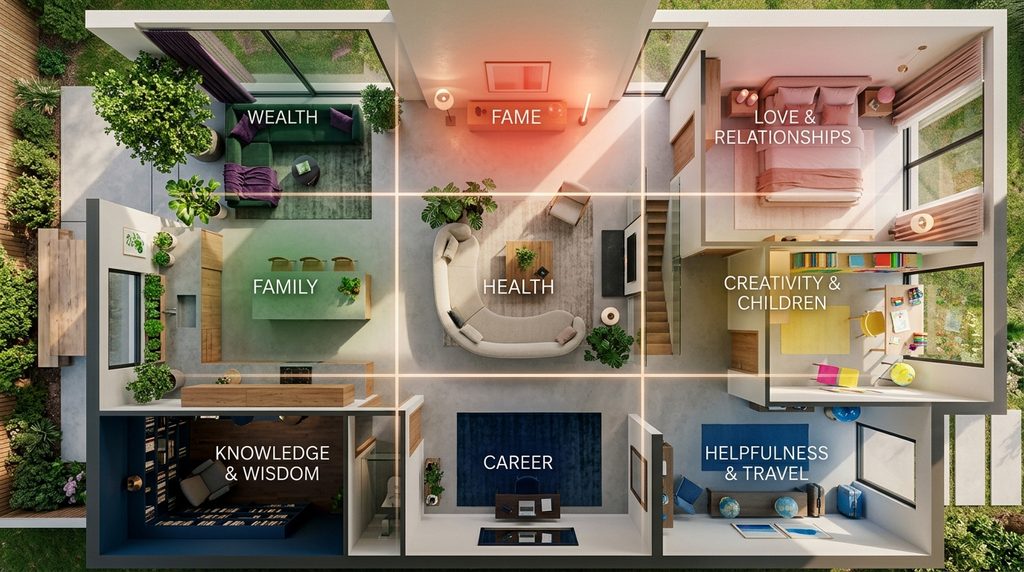
If you’ve spent any time reading about feng shui, you’ve run into the term “bagua map” — usually next to a colorful nine-square grid and advice to “activate your wealth corner.” It sounds mystical until you actually understand what it’s doing, and then it becomes one of the more practical tools in feng shui: a way to translate the layout of your home into a checklist for what needs attention.
This guide explains what the bagua map is, how the nine areas work, how to lay it over your own floor plan, and how to use color, element, and art to activate each zone — including a printable reference map you can hang directly in your home.
What Is a Bagua Map?
The bagua map is a feng shui tool that divides any space — a home, a single room, even a desk — into nine zones, each tied to a specific area of life: career, family, wealth, fame, relationships, creativity, knowledge, helpful people, and health. It comes from the I Ching (Book of Changes), where the eight trigrams, or “bagua,” represent eight fundamental forces. A ninth zone, the center, represents overall balance.
The idea is simple even if the tradition behind it is old: by overlaying this grid on your actual floor plan, you can see which life area corresponds to which physical space in your home — and use color, objects, and art to support that area.
There are two schools for how to align the map: the traditional compass method, which uses a compass reading from the center of the home, and the BTB (Black Sect Tantric Buddhist) method, which aligns the map to your front door instead. BTB is the more common approach in Western feng shui because it doesn’t require a compass reading and works well in apartments. This guide uses the BTB method throughout.
The Nine Bagua Areas at a Glance
Stand at your front door, facing into your home. The grid below maps onto your space exactly as you’d read a tic-tac-toe board — bottom row nearest your front door, top row at the back of the home.
| Area | Life Aspect | Element | Colors | Position |
|---|---|---|---|---|
| Knowledge | Self-cultivation, wisdom, learning | Earth | Blue, green, black | Front-left |
| Career | Path in life, career | Water | Black, dark blue | Front-center |
| Helpful People & Travel | Support, mentors, travel | Metal | Gray, white, black | Front-right |
| Family | Health, family relationships | Wood | Green | Middle-left |
| Health | Balance, wellbeing | Earth | Yellow, earth tones | Center |
| Creativity & Children | Creativity, legacy | Metal | White, pastels | Middle-right |
| Wealth | Abundance, prosperity | Wood | Purple, green, gold | Back-left |
| Fame & Reputation | Recognition, reputation | Fire | Red | Back-center |
| Love & Relationships | Partnership, marriage | Earth | Pink, red, white | Back-right |
Knowledge
Career
Helpful People & Travel
Family
Health
Creativity & Children
Wealth
Fame & Reputation
Love & Relationships
- Key Focus: Each area connects a specific life aspect with an element, colors, and position.
- Best Starting Point: Use the area most closely related to the life aspect you want to focus on.
- Most Practical Use: Use the position column to quickly locate each area from the front door.
- Specific Use Case: Match colors and elements to the area you’re working with.
A few things worth noting about this table before you start applying it:
- The center almost always matters most. Whatever else you fix, keep the center of your home open and uncluttered. A center that’s a cramped stairwell, a storage closet, or a dark hallway affects the whole map, not just that one zone.
- Elements generate each other in sequence. Wood feeds Fire, Fire feeds Earth, Earth feeds Metal, Metal feeds Water, Water feeds Wood. If you’re not sure whether a color choice supports a zone, this cycle tells you.
- You can apply this to one room, not just the whole house. The same nine-area grid works on a bedroom, a home office, or even a desk — which is why the wealth corner and career corner are so often talked about individually.
How To Place Bagua Map on Floor Plan
- Sketch your floor plan. It doesn’t need to be architectural — just accurate enough to show the outline and where the rooms sit.
- Mark your front door. This is your reference point for the whole grid.
- Draw a 3×3 grid over the plan, treating the outline as a rectangle. If your home isn’t a perfect rectangle, you may have a “missing” gua — a corner your home simply doesn’t cover. This is common and addressable, but it’s a deeper topic than this guide covers.
- Align the bottom row with the wall containing your front door. Your door will fall into one of the three bottom zones: Knowledge, Career, or Helpful People.
- Label the remaining eight cells according to the table above, moving row by row toward the back of the home.
Once mapped, you’ll likely notice a few zones already have some support (a green rug in the family area, say) and a few are neglected entirely. Those neglected zones are where deliberate additions — color, objects, art — make the most visible difference.
Activating a Zone With Wall Art
Once you know which wall belongs to which area, the fastest way to support it is visual: color and imagery in the zone’s element do the same job a plant or a mirror does, without needing to rearrange furniture.
A few examples:
- Wealth corner (back-left): wood-element greens and purples, with upward or flowing movement in the composition — plants, rising lines, water motifs.
- Fame corner (back-center): fire-element reds, bold and high-contrast rather than muted.
- Career zone (front-center, near your door): water-element black and dark blue, with fluid, downward-moving forms.
- Family zone (middle-left): wood-element green, straightforward and grounded compositions.
This is also where a single, correctly designed piece does more work than nine mismatched objects: a full bagua reference print, color-coded and labeled by zone, lets you see the whole map at a glance and lets guests understand it too — while functioning as a genuine piece of wall art in its own right, not just a diagram taped to the fridge.
Frequently Asked Questions
Does the bagua map change per house? Yes. The map is always drawn relative to your own front door and floor plan, so the same room can fall into a different zone in a different house. There’s no universal “this room is always the wealth room.”
Do I need a compass, or just the front door? With the BTB method used in this guide, you only need to know where your front door is — no compass required. The compass method is a separate, more traditional approach that some practitioners prefer, particularly for standalone houses.
Can I use the bagua map in an apartment? Yes — the BTB method was popularized in the West specifically because it adapts well to apartments and irregular floor plans, where a full compass reading is impractical.
What if my home isn’t a perfect rectangle? You’ll likely have a “missing” gua — a zone your home’s footprint doesn’t fully cover. This is common and has established remedies, but it’s a more advanced topic than a beginner guide can responsibly cover in a few sentences; it’s worth researching separately if it applies to your home.
Can I use the bagua map on just one room? Yes. The same nine-zone grid applies at any scale — a single room, a home office, even a desk — using that room’s or desk’s own entry point as the reference.
Is the bagua map the same in all feng shui traditions? No. This guide uses the BTB (Western) method. The traditional compass school assigns zones differently, based on compass direction rather than the front door. Neither is “more correct” — they’re different systems, and it’s best not to mix them within the same space.
Comments
[…] the bagua map — the nine-zone system used to read a home’s feng shui — the wealth area is officially […]